Market

Why Salt

Halite / Road Salt

  • According to Fortune Business Insight, the global industrial salt market size was valued at $26.92 billion in 2025, with global industrial salt market forecast expected at a CAGR of 4.4% from 2025 to 2032.
  • The United States produced an estimated 40 Mt of salt in 2025 and imported approximately 19 Mt. Apparent consumption was approximately 57 Mt, with net imports accounting for an estimated 31% of consumption.
  • Highway de-icing accounted for approximately 37% of U.S. salt consumption in 2025, while the chemical industry accounted for approximately 42% of salt sales.
MarketValueApplications
Commercial Salt$720 millionWater treatment, drilling fluids, infusion, dialysis solutions, pharmaceuticals
Chemical Use$220 millionChlorine, poly vinyl chloride
Road De-Icing$220 millionWinter road maintenance, commercial users, private households
Food Industry$300 millionFood processing, baking industry, condiments & preservatives

Why Salt Cavern Storage?

Graphics

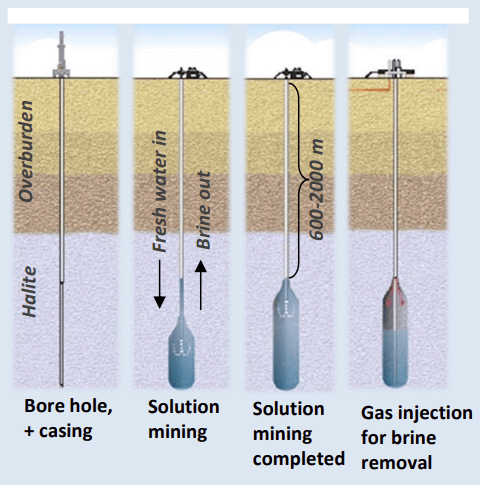
Geological Characterization

  • Thick, laterally continuous salt may occur in domal or bedded geological settings. Drilling, core analysis, geophysical logging and engineering studies are required to determine whether a particular salt interval is suitable for cavern development.

Well Construction

  • A well is drilled and cased into the target salt interval. The well and casing system are designed to isolate surrounding formations and support controlled cavern development and future operation.

Solution Mining

  • Water is injected through the well to dissolve the salt, while the resulting brine is withdrawn to surface. Injection and withdrawal configurations are controlled to develop the cavern toward its engineered shape and dimensions.

Completion and Operation

  • Following solution mining, the cavern is debrined, tested for mechanical integrity and equipped for its intended application. Depending on geology, design and regulatory approval, potential uses may include natural-gas or hydrogen storage and compressed air energy storage.

Source:

Source: https://www.energy.gov/sites/default/files/2022-04/LPO_ACES_EA_executed_FONSI_April2022.pdf

Hydrogen Market Overview

1,000 MW

The Advanced Clean Energy Storage project in Utah is aiming to be the world’s largest energy storage facility for 1,000 megawatts of clean power by utilizing hydrogen in salt caverns – $504.4 million loan guarantee (DOE)

International

Canada and Germany agreed to build a new hydrogen supply chain across the Atlantic Ocean, the 2025 target date is for the first shipments across the Atlantic

$11 Trillion

The Hydrogen industry will generate $4 trillion if revenue from products such as fuel cell vehicles are counted – with the total market potential reaching $11 trillion by 2050

642 TWh

Global Hydrogen Storage portfolio to meet the global electricity and transportation storage required based on the vehicle, ship and plane assumptions

Compressed Air Energy Storage (CAES) Market Overview

The global compressed air energy storage market size was anticipated at $7.8 billion in 2025 and is expected to grow to $38. billion by 2034.

Source: IMARC Group

CAGR of 18.72% from 2026 to 2034

Increasing deployment of intermittent wind and solar generation is creating demand for long-duration storage technologies that can help balance electricity supply and demand and support grid reliability.

Source: U.S. Department of Energy, Compressed-Air Energy Storage Technology Strategy Assessment, July 2023.

CAES uses electricity to compress air for storage in a confined space, including suitably designed underground caverns. When electricity is required, the compressed air is released and expanded through generation equipment to produce power.

Source: IEA, Glossary: Compressed Air Energy Storage

CAES offers long-duration electricity storage that supports renewable integration, peak-demand management and grid flexibility. Performance and commercial viability depend on site geology, system design and market conditions.

Source: U.S. Department of Energy, CAES Storage Assessment

Hydrogen Industry News Highlights

Newfoundland Green Transition Fund $100M

Newfoundland launches green energy transition fund using money from energy companies. Green Transition Fund valued at ~$100 million. Source: Globe and Mail

SK Ecoplant Signed a $50m US Deal with World Energy GH2

Korean company invests $50M US in World Energy’s Newfoundland hydrogen plan. Source: CBC

Haddington Ventures Announces $650M to Finance Green Hydrogen

Haddington Ventures, LLC has formed Haddinton ESP I, LP to provide construction equity for projects developed by the Advanced Clean Energy Storage Joint Venture (ACES Delta, LLC), which will be the largest green hydrogen platform in the world upon completion Source: OTPP

World Energy GH2 Pledges to Build a 1.5GW Plant Worth $12bn

World Energy GH2, known locally as Project Nujio-quonik to reflect the indigenous name for the Stephenville area, aims to house a total of 1.5GW of electrolysed capacity, powered by up to 3GW of associated onshore wind. Source: Recharge News

Carbon Market Overview